
When the Ice Breaks

Updated: Oct 4
Why the most valuable thing you can do in a conflict is also the hardest — and why good intentions make it worse
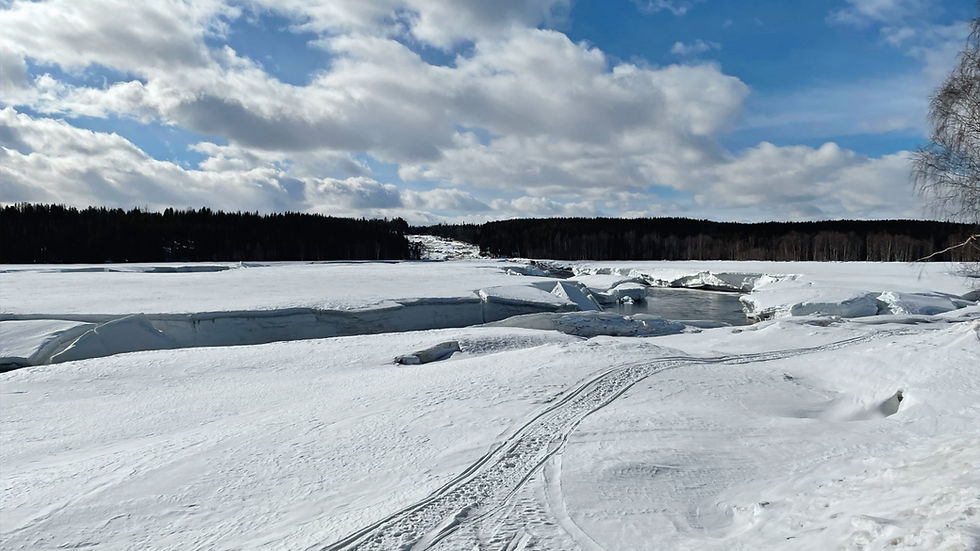
Every spring, on rivers across Sweden, something happens that is difficult to describe if you have not witnessed it. The ice, which has lain thick and silent for months and created an illusion of permanence, begins to move. Not gradually. Not gently. It starts with a cracking sound that carries for miles, followed by what can only be described as a collapse in slow motion: sheet against sheet, water forced up through the edges, masses weighing tonnes suddenly in motion.
The Swedes call it islossning — the ice release. And to the uninitiated, it is difficult to distinguish from a catastrophe.
But it is not a catastrophe. It is necessary. The ice that appeared solid and stable has been holding something back beneath the surface: movement, flow, oxygen. Everything a frozen waterway cannot give. The ice release is not the end of something. It is the precondition for what is to come.
I think about islossning every time someone tells me they want to avoid conflict.
The Chinese written character for "crisis" — wēijī — is famously said to be composed of two characters: danger and opportunity. Linguists will tell you this is a slight oversimplification.¹ But the instinct behind the saying is profound, and it points to something that Western cultures have systematically gotten backward about conflict.
We treat conflict as a problem to be solved. Ice to be thawed away. Something that, with enough skill and goodwill, we might one day eliminate entirely from our lives and organizations.
But what if conflict is not the opposite of health? What if it is — like islossning — the movement through which something frozen can finally flow again?
What actually happens when you enter a conflict?
Psychologist Lisa Feldman Barrett describes the brain as a prediction machine — an organ that constantly, based on signals from the body, constructs its best guess about what is happening and what is needed next. What she calls "the body budget" is about this: the brain's continuous work of anticipating and regulating the body's resources, maintaining the balance between what is spent and what is available.²
Conflicts — particularly conflicts with people we care about — are metabolically expensive. They cost us real energy. And when the budget is strained, the brain begins constructing predictions from a tighter space. It is not, as you sometimes hear, that the emotional takes over from the rational. Barrett demonstrates convincingly that this distinction is a myth. Rather, the brain's predictions shift: the complex, resource-intensive work of holding another person's perspective, of seeing the long view, of accommodating ambiguity — all of this competes for a budget that has suddenly become more constrained. You are not making worse decisions because you have become irrational. You are making them with narrower margins, from a smaller register, than you otherwise would.
This is where things get interesting. And this is where they get dangerous.
The fastest way to restore the body budget is to make the conflict stop. Give in. Smooth it over. Say the words that lower the temperature in the room. And so most of us, most of the time, develop a sophisticated repertoire of conflict-avoidance dressed up as conflict-resolution.
We change the subject. We offer a premature apology. We agree to something we do not actually agree to. We say "let's just move on" while the unresolved thing calcifies quietly underneath, growing harder and stranger, until it surfaces again. Louder. More entangled. Harder to touch.
There is something almost ironic in this: the more socially skilled and reflective we are, the better we tend to be at exactly this — navigating away from the real conversation while appearing to have had it. We manage the surface with great competence. What we avoid is what is moving beneath.
Making the pain stop — the short view — defeats the long view almost every time. Not because we are weak. Because we are human.
And so the question arises
If islossning is necessary — if the conflict contains the movement toward something new — what does it actually mean to help someone through it?
Not around it. Not past it. Through it.
This requires, first, that you do something deeply counterintuitive: staying in the movement with another person when every instinct in their body (and yours) is signalling that it is time to leave. It requires that you believe, with more conviction than they have in that moment, that something important is happening here — that what is breaking open is the point, not the crisis.
Many people want to do this work. The impulse is generous. The helping professions are full of people who were drawn to them because they cannot bear to see others suffer. This is a beautiful quality. It is also, in the context of conflict, a trap.
Because the desire to relieve another person's pain is fundamentally the same impulse that drives us to avoid conflict ourselves. If I am uncomfortable watching you struggle, I will intervene in ways that relieve my discomfort, not yours. I will offer solutions before I have understood the problem. I will steer the conversation toward resolution before what actually needs to surface has done so. I will, in other words, do to your conflict exactly what you are already doing to yourself: remove the pain, at the cost of the movement.
Psychologist Edwin Friedman, who spent his career studying what he called "leadership in the age of the quick fix," had a phrase for this. He called it being "a hostage to the anxiety of others."³ The person who cannot tolerate the discomfort of watching another human struggle is not a helper. They are a participant in the avoidance.
This is why wanting to help is not enough
It is, in fact, barely the beginning.
To accompany someone through a genuine conflict requires a capacity that is not self-evident. It requires that you have done enough work with your own conflicts not to unconsciously mirror your own history in the other person's situation. It requires that you have learned to distinguish between the discomfort that signals we need to leave this and the discomfort that signals something important is trying to move here and we need to stay.
It requires, in other words, not just techniques — though techniques exist and matter. It requires a fundamental orientation toward conflict: that it is not a problem to be solved, but a process to be accompanied.
There is a word for a person who has developed this capacity. The word is coach. But we should be careful with that word, because it implies a kind of distance — someone at the sideline with a notepad. What I am describing is more intimate and more demanding than that. A conflict coach is not the one who watches while you navigate. It is the one who has learned to navigate alongside you, in the movement, at the pace the movement requires — neither pressing nor retreating.
And here is something the most skilled ones understand that the merely well-intentioned rarely do: people have different capacities to bear discomfort, and that capacity changes — from day to day, from moment to moment.
Pushing someone further into a conflict than their nervous system can currently handle does not produce movement. It produces stiffness — a resistance to the very process that was meant to help. The skilled conflict coach reads this continuously. Not just what the conflict is about, but how much the person in front of them can bear right now. What can this conversation productively contain today? Where is the line between the discomfort that opens something and the discomfort that closes everything down?
This is less like surgery. More like a dance. The coach adjusts constantly: stepping closer when the person can bear it, creating space when they cannot, finding the most doable next step rather than the theoretically correct one. The goal is not to resolve the conflict as efficiently as possible. The goal is to find the path through it that the person can actually walk. Sometimes that path is steep. Sometimes it is slow and gradual. The coach's work is to find it — and to keep finding it, as the terrain shifts.
A conflict coach with only one pace, one approach, one level of intensity is not a coach. They are a well-intentioned bulldozer.
Back to the river.

What most people miss in the aftermath of islossning — what does not show up in photographs, because it is not dramatic enough — is the quiet work that follows. The water taking its time. The banks slowly reforming. What has been frozen beginning to flow in new channels.
No one presses the river to recover faster than it does. There is no shortcut. There is only the movement itself and the patience required to follow it.
That is the job. That is the whole job.
To stand at the water with someone — without rushing it, shutting it down, or pretending it is not cold — with enough steadiness to say: I know it seems as though everything is moving in the wrong direction right now. But movement is not the same as catastrophe. Sometimes it is precisely the opposite.
Friareliv runs a in-person training for people who want to develop the skills, self-awareness, and practical tools needed to work as a conflict coach and accompany others through some of the most demanding processes a person or organisation can undergo. Not because it is easy. Because it matters.
Learn more at friareliv.com/conflict-coach
Notes
¹ The wēijī (危機) etymology is widely cited but linguist Victor Mair of the University of Pennsylvania has argued at length that the second character jī is better translated as "incipient moment" or "crucial point" rather than "opportunity." The popular rendering is emotionally true even if linguistically approximate. See Mair, V., "Crisis" (2007), available at pinyin.info.
² Barrett, L.F., How Emotions Are Made: The Secret Life of the Brain (Houghton Mifflin Harcourt, 2017). Barrett's theory of constructed emotion directly challenges the notion that the brain is divided into an "emotional" and a "rational" system competing for control — a model she shows lacks empirical support. In her framework the brain is a predictive organ that constantly constructs its best interpretation of body and world. The "body budget" (allostasis) is her accessible term for the brain's ongoing work of anticipating and regulating the body's resource needs — work that is strained when conflicts drain available capacity.
³ Friedman, E.H., A Failure of Nerve: Leadership in the Age of the Quick Fix (Seabury Books, 2007; posthumously edited). Friedman, a rabbi and family therapist, applied Bowen family systems theory to organisational leadership. "A hostage to the anxiety of others" captures his central argument: that the most corrosive force in organisations is not conflict itself, but the chronic anxiety that prevents leaders from tolerating productive tension.


"...not a problem to be solved, but a process to be accompanied." The imagery of islossning brings the message home Kay, even in accompanying ourselves. Thank you.