
Maybe you've noticed: even with the best of intentions, some conversations still go in circles — and you're left wondering whether you're using the tools, or the tools are using you.
This program is for people who've already practiced NVC enough to feel where the four steps run out. It's not a step up from our Mediation Program — that program is substantial in its own right, built to give you real skill in resolving conflict well. Reimagine has a different focus: not just resolving a conflict, but growing your own capacity — your own patterns, your own presence, what's underneath the method itself.
Not refining the steps. Becoming more conscious of how you use them — and what that reveals. Through experiential practice and honest reflection, not to find the "right" way to do NVC, but to expand what you can hold: more complexity, more presence, more movement.
Who is this program for?
This program is built for people who already have NVC in their hands and are asking a different question now — not "how do I do this right," but "what in me is actually running this conversation?"
This is probably a good fit if:
✅ You've practiced NVC long enough to feel where the four steps run out — in real conversations, not just in theory.
✅ You've completed the International Mediation Program (or equivalent training) and you're not looking for more conflict-resolution skill — you're looking for growth in how you yourself show up.
✅ You're a CT, trainer, coach, leader, or facilitator, and you want to deepen your own capacity, not add another technique to teach.
✅ You're more curious about who you're becoming through a hard conversation than about resolving it quickly.
It's probably not the right time yet if:
— You're new to NVC or still building comfort with the basic model. Our International Mediation Program is the better starting point — and substantial enough on its own for most people who want real skill in resolving conflict well.
— You're mainly looking to add tools and frameworks rather than examine your own patterns and blind spots.
This isn't a step up from the Mediation Program — it's a different aim entirely. The Mediation Program builds skill in resolving conflict well. Reimagine builds your own capacity to hold complexity, presence, and perspective — in every relationship, not just the ones that are already stuck.
Q/A Recording
What participants say

I loved this program, it is quite brave because it brings in new concepts into the classical understanding of NVC and still I didn't feel at any moment that we were leaving the NVC-field, on the contrary it really expanded it and gave NVC more liveliness, flesh and soul. Thank you for this inspiring training!
— Alba Polo, Switzerland
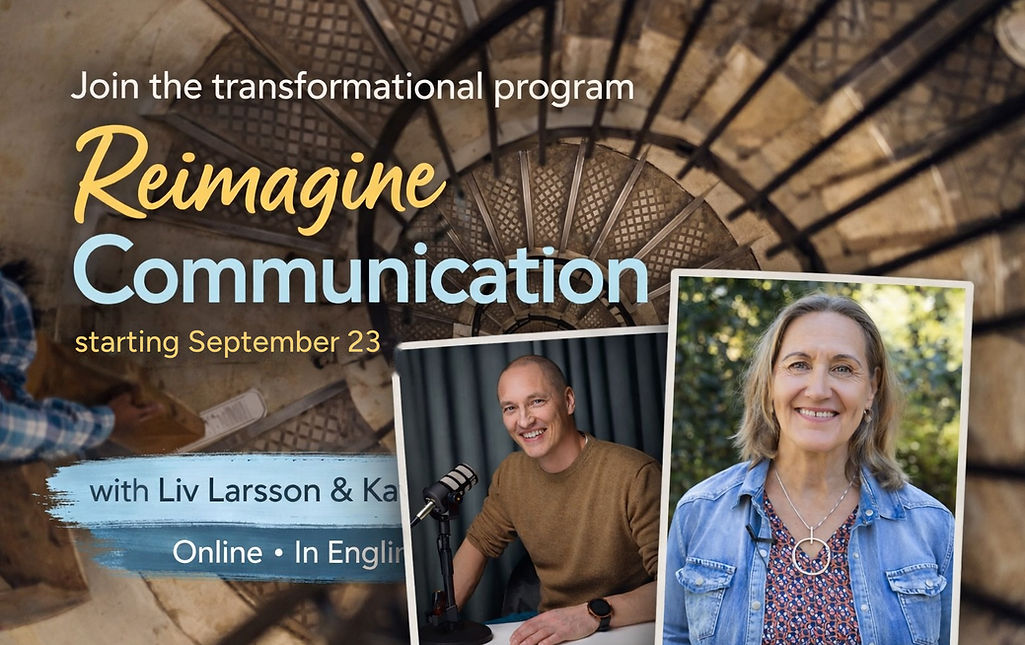
Led by Liv Larsson and Kay Rung
What is the program about?
You'll learn how to:
✔ Notice why the same NVC approach lands differently with different people — and adjust instead of assuming you did something wrong.
✔ Spot your own patterns and blind spots in real conversations, not just in theory.
✔ Handle hard conversations by seeing the need underneath someone's behavior, even when they can't say it themselves.
✔ Let NVC become something you are in a conversation, not just a script you're running.
✔ Be strong and honest about what you want and stay open and honest about what scares you — at the same time.
✔ Get better at leaning on other people instead of doing everything alone.
✔ Build a deeper, steadier kind of compassion — the kind that holds up under pressure, not just in easy moments.
This program draws on how adults keep growing and changing throughout life — not just what we know, but how we see. Both matter, and we work with both.
Nonviolent Communication is a powerful way to create connection. But most people who practice it for a while hit the same wall: it gets hard to use exactly when you need it most — when the other person won't open up, when the conflict is already stuck, or when you're too flooded to remember the steps. This program is built to work with that wall directly.
Topics
We build these into a real relationship project you're working on during the program, so none of this stays theoretical.
Empathy that holds under pressure — Real empathy isn't just "I hear you're upset." It means staying with someone's full humanity, including the parts you don't like or agree with. It gets easier the more you practice staying present when it's uncomfortable — for you, not just for them.
Using your power on purpose — You're always affecting the people around you, whether you mean to or not. The question isn't whether you have influence — it's whether you're using it on purpose. What changes when you own your impact instead of either taking charge of everything or going quiet and letting things happen to you?
Working inside hierarchies — Hierarchy and structure aren't automatically bad — sometimes they help a group actually get things done, and sometimes they just protect people at the top. Learning to tell the difference, and to hold your own ground inside a structure you didn't design, is a skill you can build.
Where NVC goes wrong — NVC can open real conversations. It can also become a new way to look right — "I'm just naming my feelings" used as a move to win instead of connect. What does it look like when empathy turns into performance, or when someone treats their "need" as the one true fact in the room?
Your feelings aren't as fixed as they feel — We tend to treat our emotions like plain facts about who we are. They're not — they're shaped by what you were taught, your culture, your body, your history. That's not bad news. It means you have more room to work with your emotional reactions than you think.
Seeing it from someone else's side — Taking someone else's perspective is a muscle, not a fact you either have or don't. Use it and it grows; ignore it and it shrinks. It doesn't mean giving up your own view — just being able to genuinely try someone else's on. When did you last let yourself be surprised that way?
Money, success, and what "enough" means — What actually counts as success for you — recognition, freedom, making a difference? Money carries more than its price tag: security, status, sometimes shame. And generosity isn't only about giving — being able to receive well is part of it too.
Catching your own automatic reactions — Some of your beliefs and habits you can already step back and question. Others are so close to you that you don't notice they're running the show. A big part of this work is learning to spot more of those — turning automatic reactions into things you actually get to choose.
What triggers you is information — What sets you off in other people often says as much about you as it does about them. That's not a flaw to fix — it's data. What is your reaction actually trying to show you about your own story?
Two different kinds of growing — Sometimes growth means picking up more skills and knowledge — more tools in the kit. Other times, something deeper shifts: the way you actually see and make sense of things changes, not just what you know. Can you tell which kind is happening to you, and when?
Gratitude as a practice, not a mood — Gratitude doesn't have to be something that just happens to show up on good days. It can be something you build — noticing what you'd normally walk right past. Not forced positivity — just seeing more clearly.
How you talk to yourself — The way you talk to yourself in your head is usually the story you're living inside without noticing. Self-love isn't constant cheerleading — sometimes it's just sitting with something uncomfortable instead of turning away from it.
Carrying your own weight — and letting others help — Being responsible doesn't mean doing everything alone. Sometimes the most responsible thing you can do is say "I need help right now." How do you get good at both — carrying your share, and letting yourself be carried?
What you’ll walk away with
✔ A deeper understanding of human development and how it helps us meet people where they are.
✔ Tools to navigate emotionally charged or complex situations in a more efficient way
✔ Insight about your own growth and how it shapes your relationships.
✔ A deepened capacity to experience compassion - not just as a technique but as a way of life.
✔ Wider capacity for perspective-taking.
✔ Enhanced self-reflection and self-love.
✔ Having clearly identified pitfalls for NVC - practitioners
The practicalities
We meet as a large group 15 times for 3 hours, and in smaller exploration groups 14 times (mostly online) for development exercises, reflective dialogues, and hands-on applications.
Individual application work includes literature, integral life practices, and a designed workbook.
📆 Program duration: 23 September 2026- 2 June 2027
Download .ics file to your callendar!
Teacher led sessions 18:00-21:00 CET (Stockholm), (translates to Istanbul 20:00-23:00, New York 12:00-15:00, LA 09:00-12:00.
23 September 18-21 CET (Stockholm) 1 30 September 18-21 CET (Stockholm) 2 7 October Exploration group 1 14 October Exploration group 2 28 October 18-21 CET (Stockholm) 3 4 November Exploration group 3 11 November 18-21 CET (Stockholm) 4 18 November 18-21 CET (Stockholm) 5 25 November Exploration group 4 2 December 18-21 CET (Stockholm) 6 9 December 18-21 CET (Stockholm) 7 16 December 18-21 CET (Stockholm) 8 6 January Exploration group 5 13 January 18-21 CET (Stockholm) 9 20 January 18-21 CET (Stockholm) 10 27 January 18-21 CET (Stockholm) 11 3 February Exploration group 6 10 February Exploration group 7 17 February Exploration group 8 24 February 18-21 CET (Stockholm) 12 3 March Exploration group 9 10 March 18-21 CET (Stockholm) 13 17 March Exploration group 10 7 April 18-21 CET (Stockholm) 14 14 April Exploration group 11 21 April Exploration group 12 19 May Exploration group 13 26 May Exploration group 14 2 June 18-21 CET (Stockholm) 15
3 steps to get started
✅ STEP ONE —Pre-register, even if you're unsure about attending but interested. No obligation required at this step.
✅ STEP TWO — After registering, you’ll receive instructions on how to complete your registration and payment.
Price: €2195
✅ STEP THREE — Once your payment is processed, you’ll receive login information and gain access to the program forum.
Cancellation Policy:
At step 2, you reserve a seat in the program. You may cancel your reservation to 30 days before the program start date with a fee of 50€. Cancellations made less than 30 days prior to the start date will incur a charge of 50% of the program fee.
Cancellations made after the program has started are non-refundable, as these funds cover the trainer team's salaries and administrative costs for the program duration.
Payment options
If you wish to pay in installments, we’re happy to support that.
Please email us at and let us know that you’d like to arrange a payment plan.
Meet the Team

Liv Larsson
Liv Larsson is the author of 24 books. She has been a Certified trainer for Center for Nonviolent Communication since 2002 and an educator since 1992. With over 30 years of experience as an educator and mediator, she has worked with diverse groups and contexts — from small organizations to complex, multi-stakeholder conflicts. One example includes mediating between the Indigenous Sámi people and actors in the forestry and mining industries in Scandinavia.
Holding a Master’s degree in Literature and Creative Writing, Liv combines a deep appreciation for language with a lifelong interest in human connection and development.
Liv has been leading trainings all over the world on different themes and for different audiences for more than 3 decades. She has developed different maps to use in finding how our inner terrain unfolds in connection with the outside world.
She has trained with Terri O’Fallon (founder of STAGES International) and Robert Kegan (Immunity to Change), integrating adult development theory into her work with communication, inner transformation, and leadership..
Liv is passionate about cross-country skiing and loves to spend time in nature and lives in the forest of northern Sweden.


Kay Rung
Kay Rung is an empathy trainer, mediator, and publisher with over 20,000 hours of hands-on experience in communication and conflict transformation. Since 1999, he has worked internationally with individuals, teams, and organizations to foster conscious, collaborative relationships that can meet complexity with clarity.
Grounded in Nonviolent Communication and integral thinking, Kay supports people in navigating tension and difference without losing connection. He is especially skilled at guiding others through conflict — not by avoiding it, but by making it a gateway to deeper understanding and transformation.
Together with Liv he co-leads their international mediation program and brings in his awareness on perspectives as well as development. He leads a in-depth NVC program in Swedish.
He also coaches leaders who want to bring empathy, presence, and systemic awareness into their personal and professional lives.
He has two successful podcasts in Swedish.
Kay lives in northern Sweden, close to nature and the changing seasons.
With a curiosity for how systems function — internally and collectively — he finds energy in meaningful dialogue, simplicity, and the everyday practice of living what he teaches.

Assisting us:
Anniken Poulsson Beer
Anniken Poulsson Beer, certified trainer with CNVC (Center for nonviolent communication) since 2012, and the first one in Norway to become certified.
Her background is from Early Childhood Education, and she has been a principal for many years. She works as a freelance trainer in Norway and abroad, with workshops, indvidual coaching and lectures.
Anniken is the CEO of NVC Norway and an assessor.
She has participated in the Reimagine Communication program 2025-26.
Her aim is to share NVC with clarity, care and humor.